

How many chord shapes have you memorized? Dozens, probably. And with each new chord encountered in a tab, back to the diagram dictionary. Here’s the good news: all these chords come from ONE single three-note formula. You know degrees and their major or minor quality: it’s time to build the chords themselves, and never depend on a diagram again.
The essentials in 30 seconds
A chord is a set of at least three notes played together. The basic chord is called a triad and is built with a simple formula: a root, a third and a fifth. The root gives its name to the chord; the nature of the third decides its color. A major third (4 semitones) produces a major chord, bright, while a minor third (3 semitones) produces a minor chord, darker, the perfect fifth (7 semitones) remaining identical in both cases. Knowing this formula allows you to build any chord yourself, without resorting to a diagram.
1. What is a chord: three stacked notes, the triad
A chord is at minimum three notes played together. Three different notes, not three strings: crucial nuance. Take your open C major, the one you play on five strings. Count the actual notes: C, E, G, then again C and E. Only three different notes, the last two are octave doublings (same name, same role in the chord, we saw that with the octave in the first lessons).
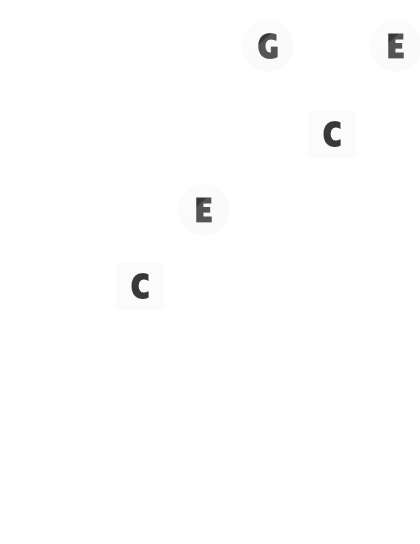
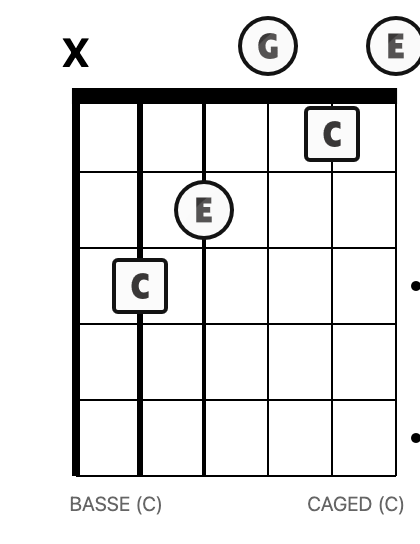
This three-note chord has a name: the triad. And a chord shape is nothing more than a triad laid out on the fretboard, with doublings to fill it out. Dozens of shapes, one single structure.
And your power chords, then? Only two notes. Strictly speaking, it’s not a triad: it’s an incomplete chord, missing precisely the note that decides everything. Hear the difference:
2. Root, third, fifth: the formula of every triad
A triad is built like a tower, by stacking two thirds (the third and the fifth, the chord’s building blocks, you know them). Three floors, three roles:
The root is the identity: the note that gives its name to the chord and on which everything stacks. The third is the color: 3 or 4 semitones above, it and it alone decides major or minor. The perfect fifth, 7 semitones from the root, is the body: stable, somewhat neutral, it solidifies without changing the mood.
Calculate the third and fifth in semitones
Root or tonic? The two “base notes” of the series
Watch out for the vocabulary trap, now that both words exist. The tonic is degree I of the scale, the piece’s center of gravity: one per key. The root is a chord’s base note: each chord has its own. In C major, the G chord (degree V) has G as its root… which isn’t the tonic, it’s the dominant. In the same piece, you play lots of roots, but only one tonic.
3. Major or minor: one single note changes everything
Go back to the tower: the root doesn’t move, the fifth doesn’t move. Only one variable remains, the third. At 4 semitones, the chord is major, with a bright color. At 3 semitones, one single fret lower, it becomes minor, darker. It’s a reliable guideline as a first approach, not a law: context can make a minor chord sound gentle or powerful. But the contrast, your ear already knows it by heart.
On your guitar, this shift is physical: go from A major to A minor, from E major to E minor. In each case, only one finger moves, by one single fret. That finger was the third. You knew it without knowing it.
4. Build a chord you don’t know
Build F sharp major without a diagram
The ultimate test: a chord you’ve never learned. F sharp (F#) major. Apply the formula: root F#. Plus 4 semitones: A#, the major third. Plus 7 semitones from the root: C#, the perfect fifth. F# major equals F#, A#, C#. Find these three notes on your fretboard (you know how to calculate them from the article on notes), play them together: done. No diagram consulted.
One more, with flats: A flat (Ab) major. Ab, plus 4: C. Plus 7: Eb. Ab major equals Ab, C, Eb. Notice that spelling follows the same rule as with scales: a different letter per note (A, C, E), it’s what decides between the two names of the same fret.
Switch a chord to minor
You want the minor? Drop the third by one fret. F# minor equals F#, A, C#. Bb minor equals Bb, Db, F. The formula does everything, in both colors, from any root.
To check your constructions and check your chords and explore positions, Twelve Assistant’s Chord Diagram Library displays each chord in all its shapes on the fretboard.
Going further: inversions
A C major is C-E-G, regardless of order. If you put E (the third) in the bass, it’s still C major, but “inverted”: same chord, same root, different foundation. We notate it C/E. The lowest note (the bass) can change; the root, never. We’ll really exploit this tool in the article on harmonization.
5. The chords of the major scale
Why I, IV, V are major and ii, iii, vi minor
Last puzzle piece, and it loops back to degrees. Stack two thirds on each degree of the C major scale, staying within the major scale notes: you get the 7 diatonic chords, the key’s “home” chords. And their qualities aren’t a choice: it’s the scale formula that imposes them. I, IV, V come out major; ii, iii, vi come out minor; and vii° comes out diminished: two stacked minor thirds, whose fifth isn’t perfect but diminished (6 semitones… the tritone). The mystery of the vii° badge from the previous article is solved.
A fourth triad quality exists, the augmented chord (two stacked major thirds, augmented fifth): rarer, absent from the major scale, you’ll encounter it as a passing color. We’ll leave it there for today.
On your guitar: three challenges this week
Challenge 1. Deconstruct three open chords you already play (C, G, E minor): name each string and spot root, third, fifth and doublings.
Challenge 2. Build B major then Eb major by calculation, without a diagram. Check by sound: full and bright equals success. Hollow or weird equals recount your third or fifth.
Challenge 3. Blind test: 10 major/minor chords, 8 right answers minimum. You already trained isolated thirds (article 3): complete chords are easier than you think.
Frequently asked questions about guitar chord construction
What is a chord in music?
A chord is a set of at least three notes played simultaneously. The most common chord is the triad, composed of a root, a third and a fifth. On guitar, a five or six string chord shape actually only plays these three different notes, simply doubled at the octave. A chord is therefore not a finger shape to memorize, but a stack of notes following a formula.
How do you build a chord on guitar?
To build a triad, you start from a note called the root, then add two notes calculated in semitones. You go up 3 or 4 semitones for the third, then 7 semitones from the root for the perfect fifth. For example, an F sharp major is built like this: F sharp (root), plus 4 semitones gives A sharp (major third), plus 7 semitones gives C sharp (fifth). You just need to find these three notes on the fretboard and play them together, without needing a diagram.
What’s the difference between a major chord and a minor chord?
The only difference lies in the third. A major chord uses a major third (4 semitones above the root) and sounds bright. A minor chord uses a minor third (3 semitones) and sounds darker. The root and perfect fifth remain identical in both cases. On guitar, going from major to minor thus comes down to lowering the third by a single fret, which is enough to completely change the chord’s mood.
What is the root of a chord?
The root is the reference note on which the chord is built and which gives it its name: the root of a G chord is the note G. It’s from it that we calculate the third and fifth. In guitar shapes, the root is often the chord’s lowest note, but it can also be doubled at the octave on other strings. Identifying the root is the first step to understanding or building any chord.
What are the chords of the major scale?
By harmonizing a major scale, you get a chord on each of its seven degrees, with a fixed quality. Degrees I, IV and V give major chords, degrees ii, iii and vi minor chords, and degree vii a diminished chord. In C major, this gives C, D minor, E minor, F, G, A minor and B diminished. This distribution is the same in all major keys, which explains why the same chord progressions come back from one piece to another.
Summary
- A chord equals a triad: root (identity), third (color), fifth (body). Guitar shapes just double these three notes.
- Major or minor: the third decides, one fret apart. Root and fifth don’t move.
- Root ≠ tonic: each chord has its root; the key only has one tonic (degree I).
- The formula builds everything: +3 or +4, then +7 from the root. F# major, Ab major, Bb minor: no more need for diagrams.
- The 7 diatonic chords come from the scale with their imposed qualities: I, IV, V major; ii, iii, vi minor; vii° diminished (its tritone included).
You no longer memorize shapes. You build chords. And you now know exactly what you’re playing when you strike a C.
Explore each chord in all its positions
You just understood how a chord is built. The Chord Diagram Library displays each chord in all its shapes on the fretboard. No account, no credit card.
Open demoAnd on the guitar?
A chord is three notes (the triad) that you can find just about everywhere on the fretboard. guitar triads on the fretboard shows you how to form them string by string, far beyond open positions.
Continue the series
Scales, degrees, chords: the harmony core is in place. Now, a more subtle question: why can two pieces using the same notes sound so different?
Welcome to the world of modes: other colors, hidden in a scale you already know.
Article 7: Guitar Modes → ← Previous: Article 5: Scale Degrees · Back to music theory table of contents